Swimming - Breathing under water
Helpful Tips
- The key is to stay as relaxed as possible.
- It does take some time for your body to get used to structured breathing. With time, your body will get more more efficient at using oxygen. That will make things easier with breathing.
- Don’t focus on keeping your arms straight or bent. It probably helps if they are bent, not straight.
- Start slooooow.
Mistakes
- Improper movement of the non-catch arm
- When inhaling, the front arm should be in front of the body. Turn the head to the side.
- Use this arm for support on the water and to help with the streamlined body position.
- After the breath, turn the head and upper body back to the neutral position BEFORE STARTING THE NEXT ARMSTROKE.
- If your head is turned to the side when we do the next armstroke, the arms will follow the wrong trajectory into and through the water. We will loose support in the water.
- You can start a new armstroke only when the head is turned back to the neutral position.
- Taking big gulps of air. Gasping and gulping for breath. Rushing your breath.
- The goal is - nice rhythmic and relaxed breathing style - just the way we breathe when we are not in the water.
- We are more calm when our lungs are not totally filled with air.
- A relaxed breathing pattern increases endurance and reduces fatigue.
- Trying to hold your breath.
- It will make the body tense. The shoulders will not be able to move efficiently.
- It will build up CO2 in our lungs.
- When the head is out of the water, we have to exhale + inhale. With less time, it is very difficult to do both.
- The answer is trickle breathing.
- You are not rotating well.
- With each stroke, the body needs to be rotating - thereby, exercising all the muscle groups.
- When it is time to take a breath, the head needs to rotate along with the rest of the body.
- Without good rotation, getting the head out of the water is going to be difficult.
- Poor body/head positions
- The movement for breathing has to be timed with the stroke.
- After taking a breath, the head must return back into the water before the arm recovers and enters the water. Start a new armstroke when the head is back in the neutral position.
- Kicking too hard.
- Legs are a big muscle group. If we are kicking too hard, they have a high intensity. That will demand a lot of oxygen - leading us to run out of breath quickly.
- We want to make sure they are not doing too much work other than to help maintain balance in the water and a little bit for propulsion.
- Not following a pattern.
- one breath per two/three strokes. It is important to know where those breaths are. That mental game plan is very important.
- Trying to swim too fast or too hard.
- Aim to swim slower and easier.
Trickle breathing
- When we take a big gulp of air and try to hold on to it, our bodies really don’t react to that well. Wierdly, holding your breath actually makes you feel like you are more desperate for air because the build-up of Carbon Dioxide in our lungs and blood will trick your mind. So once we’ve taken that breath, we should start exhaling as soon as our face is back in the water and there should be a constant stream of bubbles known as trickle breathing.
- Breath out underwater, so when you turn your head or lift it for a breath (breaststroke and butterfly), you are only inhaling. People tend to be puffed when they forcibly exhale then inhale all when their face is out of the water. Don’t hold your breath under water. That will build up CO2. Exhaling into the water helps us clear out CO2, the buildup of which creates a suffocating-like feeling that hurts endurance (and form).
- Breathe in with the mouth and breathe out with the nose. Nostrils are smaller than the mouth.
- How to practice?
- Sink downs - roll ourselves into a little ball and then trickle breathe the oxygen from the lungs really slowly as we sink down to the bottom of the pool. This helps with relaxing and getting used to letting oxygen out really slowly.
Bilateral breathing
- Breathing to Both Sides
- Example: breathing every 3 or 5 strokes.
- Benefits of bilateral breathing include a more balanced stroke, helping you roll from side to side, and it gives you more time to exhale before your next breath.
- Learn to turn to both sides to breathe.
- You will not hurt one side of the neck by over using it.
- It is very useful when swimming long distances. Another benefit is, you can see your friends/competitors on both sides.
https://blog.tritonwear.com/how-a-bilateral-breathing-pattern-will-make-you-a-faster-freestyler
Techniques for Breathing
How do we get that breath in?
During
- When swimming, we want to stay as streamlined as possible, but then tilt our head just enough so we can get that breath in. It is about the timing. When the arm is going just past our head in the water is when we should be rotating on the opposite side to breathe.
- Rotate your hips so you can turn to breathe.
- Look to the side of the pool. Do not lift your head in front to breathe.
- When breathing to the side, turn your head to the side of the pool but not lift your head - preferably, not up at the sky.
- Do not lift your head in front to breathe. Turn to your side. If you lift your head in front, your feet will start to sink.
- We need to be aware of the subtle difference between lifting your head to the side and turning your head to your side without lifting it.
- An easy test for this is, the other ear and a part of the other side of the goggles should not come out of the water.
- When you are turning your head, do not overturn.
- When breathing to the side, do not choke on water. Turn your shoulder wider. That way, you don’t have to turn your neck so much. In the beginning, you can think of it as your shoulder is pointing to the sky when turning.
- Finding the balance between turning the shoulder wider and not turning the head too far is the key. Finding that sweet spot between the two is important.
- Do not turn our head too far. You should not see the sky or the roof of the building when you turn. If you do that, your hand has to go way beyond your head in the movement. If you think of it like X-axis and Y-axis, your hand should not go beyond the Y-axis line. If you do that, you will lose your balance. Overturning is also not good for your shoulders. Just look at the side of the wall while swimming.
- Breath on one side as you shoulder rotates out of the water. Don’t lift your head to breath, there is a pocket formed by the water moving past your head. Relax your arm in the recovery phase of the stroke. Beginners often lift their heads when breathing trying to get as much distance from their mouth to the water’s surface as possible. This causes the legs to drop and increases drag. It is worth practicing breathing correctly to increase confidence about getting enough air.
- Leave your catch arm extended while you take a breath.
- If you try to catch and pull the water with that arm while taking a breath, you will sink.
- As you turn your head to breathe to one side, your arm on the opposite side should extend in front of you. This helps keep your body up and supported, making it easier to take a breath. For example, if you breathe to your right side, your left arm should be extended.
- Get your hips up (by doing the leg kick well)
- If your hips sit too deep beneath the surface when you try to stay low during the breath your mouth won’t get out the water.
- Raising your hips up to the surface will level your body out. That means that, as you rotate for the breathe your mouth will clear the water and you’ll breathe in fresh air!
- When you are turning to the side to breathe, you are putting your balance in jeopardy. So the less time you take to breathe and put your head back in the water, the better. Take less time to breathe.
- Do “bilateral breathing”
After
- After taking a breath, the head must return back into the water before the arm recovers and enters the water. Start a new armstroke when the head is back in the neutral position.
- For slow and calm swimming, you should be breathing on every third stroke, or even less frequently, but it’s totally OK to switch to breathing on every second stroke when you’re going hard or start to feel winded.
Drills
-
Side-kick. Face facing the side of the pool and arms by our side. Assuming we are swimming along next to the wall, turn your head slightly towards the wall to get a breathe, and then flip round to make sure we come out on the other side coming back.
-
6 kicks 1 stroke - take one stroke and then kick six times on one side. This is to teach us constant breathing on the surface of the water before taking another stroke and switching sides.
-
1 arm stroke - to build the stroke back up, we can add one arm. There is a few variations on this. To start with, we can keep the left arm forward and do the stoke with right arm only and breathe on the right side. The other variation is a little more difficult. Keep the left arm by the side of the body. Do the stoke with the right arm and breathe on the right side.
-
Hold a paddle board in one hand. Do hand movements with the other hand and try breathing on that side. Focus on the movements and body rotation and identify the mechanism, mistakes and areas for improvement.
-
Do kick drills with a kickboard, placing your hands over the kickboard keeping it under the water surface. This helps with posture.
-
Do side kicks using the kickboard on both sides, concentrating on breathing with head rotation (not lifting the head).
-
Do drills only with arm pulls holding the kick board between your lower legs. This helps with posture.
https://www.reddit.com/r/Swimming/comments/17pnjuq/i_cant_breathe_when_doing_freestyle_what_am_i/
Hang on to the edge of the pool, put your face in the water and kick your feet, so you’re horizontal with the water.
Practice turning your head for good breathing.
If this prevents issue, have someone hold your legs so you don’t have to kick to stay horizontal (or get a bouy to put between your legs), and try just learning how it feels to turn your head for a good breath.
Once you get used to that, just use one hand to hang on edge of pool. Use other hand/arm to do the free stroke. Practice breathing on that side. Switch hands and repeat on other side.
My guess is you’re concentrating so hard on coordinating your stroke and kick that it’s messing with breathing.
Also, you do realize that the “half turn” your head does is really a bit more than half. Your entire mouth and both nostrils need to come out of the water.
https://rocketswimming.com/how-to-breathe-when-swimming-for-beginners-2022/
Sinking on one side when practicing freestyle
If you’re experiencing sinking on one side when you’re practicing freestyle this is what’s happening.
Why you may be sinking on one side versus on the other.
The problem: When we are breathing over our right shoulder, our left side is lower. And as we are breathing, the whole body starts to droop after we take a breath over our right shoulder.
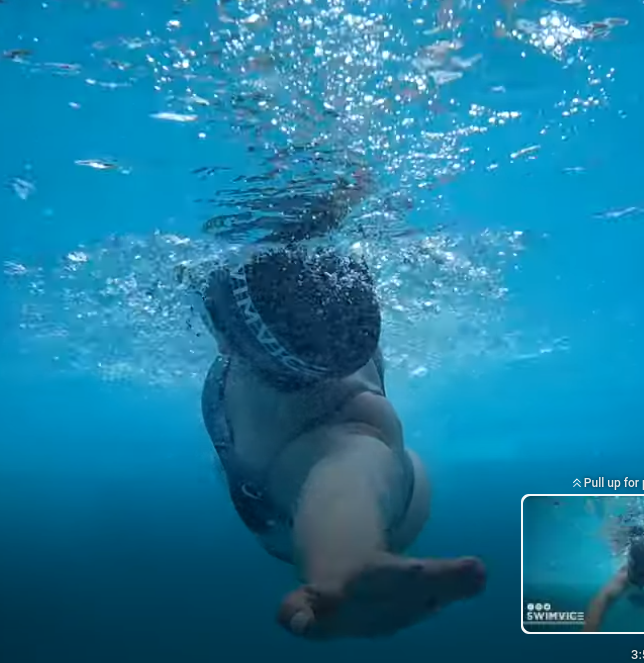
The reason why this is happening is due to over rotation. What causes that sinking is, our body is literally stacked 90 degrees shoulder to shoulder. When this happens, and you linger with a breath or take too long, the weight of my right arm in this case is sinking my body down or sending energy to the bottom of the pool versus forward.
So if you ever feel that, every time you take a breath on one side, it makes your weaker side droop or you feel that kind of droopiness, a disruption and interruption in your rhythm, this is what’s happening. And when that happens, your whole body will start to sink. Depending on the person, that sinking will be more dramatic than others. That’s all dependent on how long you’re taking for that breath and also the weight of your arm sending you down.
As you practice, you can actually manipulate this movement by over rotating, lingering. Feel that difference of what happens to your body position when you do this on purpose. This will help improve your awareness and help you correct it.
How to correct it?
We can eliminate that sinking feeling and trim things up by keeping things short and sweet. That is, do not linger on your breath and also do not over rotate.
There needs to be a difference in the angle between the right and left shoulders. A 45 degree angle (or lesser than that) from shoulder to shoulder. We are not completely stacked and with that angle, it’s just enough rotation. Anything more than that is going to cause sinking.
With that, we will be nice and stable. We will feel that we are on the surface. We will be able to get a breath easily. The head’s still fairly low in the water. But, due to the timing being quick, that lingering is gone. Now, each breath feels very much in sync, in tune, in rhythm with the rest of the freestyle and it doesn’t really interrupt anything.
And we will be able to get a better breath.
Now, it may feel rushed for those that aren’t used to it. But as you get more comfortable, you’ll start to realize that our body line doesn’t change. It actually stays exactly in the same level. It’s not up or down. It’s fairly consistent.
When you’re practicing breathing, keep in mind that not every breath is going to be absolutely perfect. You’re going to have breaths that are off. Most people do as well. When i’m practicing it’s not going to be a hundred percent each time. But the key is, when you are off on a breath, you know why that’s happening and that you aim to refine each breath over time. And what will happen is, the majority or the foundation of your breath will stay intact, and then here and there, there will be some deviations. But overall you’ll feel more comfortable and you have a path to get better.
Those are some tips to keep in mind when you’re practicing freestyle breathing.