Tennis - rackets, grips and overgrips
Tennis Racket Handle
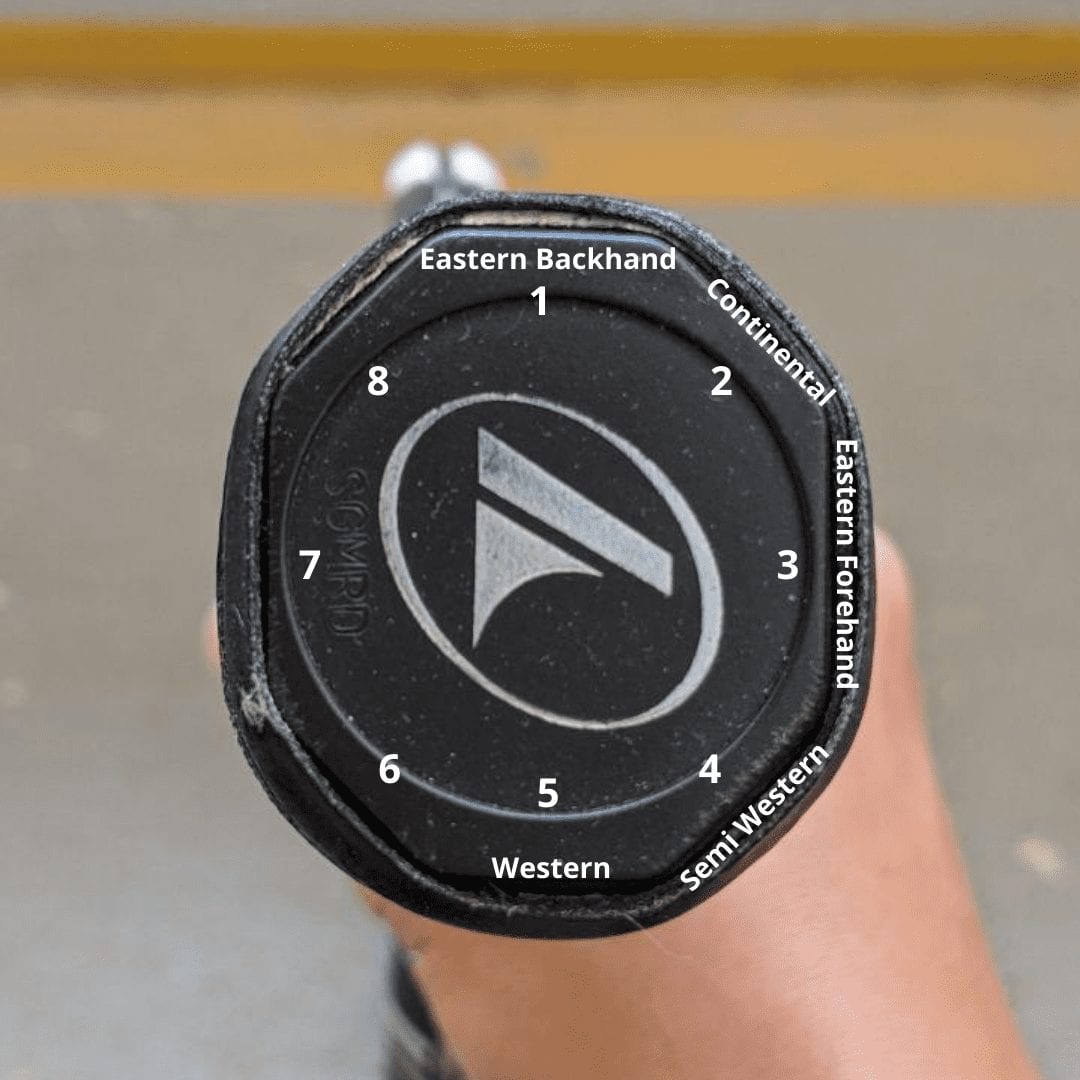
The tennis racket has 8 bevels. How you rest your hand on the handle determines what grip you are using. Have a look at the images below. The fleshy part of the index knuckle will be placed on the appropriate bevel.
e.g. On number 4 and it’ll be the semi western grip. The grip is held across the palm. Do not hold it like a you would a bicycle handle.
Grips
(from The Inner Game of Tennis)
If you were to ask ten tennis players why they hold their racket with one grip when hitting the forehand, and a different grip when hitting the backhand, most would probably answer that they read it in a book or magazine, or were taught it by their pro. Even though what they were told might be “correct,” if they have little experiential understanding of grips or why you change them, it is unlikely that they will really discover the best grips for their game.
A great deal of information about grips is readily available. One reason players have learned to change grips is to provide the strongest bond between racket and hand on each shot. But because every hand is slightly different, the exact positioning of your grip should be adjusted according to what is comfortable for your hand, while allowing the desired support and racket angle.
The same goes for how tightly you should grip the racket. Just try to describe this in language! My best effort at this was borrowed from a fencing instruction given to Cyrano de Bergerac:
Hold the foil as a bird, not so loosely that it can fly away, but not so tightly that you squeeze the life out of it.
It is a nice metaphor. But in reality, the only way to find the right degree of pressure to apply to the grip is by experiencing it in action and discovering what feels comfortable and what works.
If you have been following the evolution of “approved” grips in the last few years, you will have noticed the dominance of the universally approved Eastern forehand grip (“shake hands” grip with the V formed by the thumb and forefinger on the top panel of the racket). Although this is still the grip approved in United States Tennis Association publications, it has been abandoned by many tournament players in favor of the “semi-Western grip” (approximately a quarter turn to the right of the Eastern grip—for right-handed players). How did these players come to use this grip? And why are they sticking with it? Could it be that they discovered it, and that their experience has continued to validate its use? They broke with dogma, not because the dogma was wrong, but because they found something that worked better for them.
A variety of grips are required, often within a single point
https://www.theguardian.com/lifeandstyle/2009/jun/28/tennis-learn-grips
Adjusting the grip you take on a tennis racket is a way of altering the angle of the racket face as it meets the ball. Most of the time, as you trade forehands from the back of the court, you will have your own standard grip based on your strengths and weaknesses. This should change to a different, flatter grip for serves, volleys, smashes and slices. Both grips can be reversed to play backhands, while the two-handed backhand has a grip of its own.
A good way to understand different grips in detail is to move your hand around the handle of the racket in a clockwise motion. Left-handers should move the same distance anti-clockwise in all cases. Imagine that the top of the handle (ie the narrow side, looking down on the edge of the frame) is 12 o’clock.
Continental
The basic, neutral grip - known as a continental grip - is formed by placing your hand on the racket so that the V formed by your thumb and forefinger are at roughly 11 o’clock (or one o’clock if you’re left-handed). This is the flat grip you would use to serve, volley or smash. You can also use it to slice a delicate dropshot from the back of the court, as it allows you to hit down on the ball, punching through it to impart backspin.
Eastern
Move your hand clockwise around the racket, so that the thumb-finger V is somewhere between 12 and one o’clock. This is an eastern grip, which is similar to what you would get by “shaking hands” with the racket in a very relaxed way. This allows for a small amount of racket acceleration up the back of the ball, which will spin it slightly, keeping the ball relatively flat.
both index and heel of hand on bezel 3. flat shots. good for low and medium height balls. not good for high balls.
Semi-western
If you move your hand further round, the wrist comes into play, and it puts the racket into a much deeper position, which allows you to hit up the back of the ball a lot more and generate more spin. If the V is between two and three o’clock, you’re using a semi-western forehand. Somewhere around here is the ideal grip for the modern game, where you’re trying to generate both spin and weight of shot through the ball.
heavy topspin and fast, flat shots. both index and heel of hand on bezel 4. good for all heights of balls. good for any surface courts.
Full western
With the V anywhere beyond three o’clock, you’d be playing a full western forehand, which is what a lot of the clay-court Spanish players use. In fact, they twist their grip so far that they actually hit the ball with the opposite face of the racket, which generates an awful lot of racket speed and lines up the strings, so they can spin the ball in a steep low-to-high movement.
(extreme) allows more spin. shots will be slow. more of a defensive play. both index and heel of hand on bezel 5. good for high balls. not good for low balls.
Backhand
To change your grip from a forehand to a one-handed backhand, use the clock principle, starting again from the continental grip but this time moving the same amounts anti-clockwise, depending on how much spin you wish to impart. In practice, most one-handed players stick with a roughly eastern backhand.
Two-handed backhand
Using a two-handed backhand is a bit like playing a forehand with your wrong hand, so for right-handed players, the left hand does all the work and the right is there solely for support. There are three or four different grips you can use, but a standard two-handed backhand would position the right hand in a neutral continental grip, while the left hand would adopt an eastern forehand grip higher up the racket handle.
Now try this …
The problem with most two-handed backhands is that the dominant hand thinks it is the one that plays the shot. A great way of practising is to take your racket in the two-handed grip then remove your right hand and practise playing left-handed forehands, swinging low to high, while keeping your left hand at the top of the grip. This will teach the weaker hand to control its swing when you eventually put the other hand back on again.
What am I doing wrong?
A classic mistake people make with their grip is not bringing the racket back to their non-dominant hand to help them change it. As a result, they often stay in the grip of the shot that they hit most often (usually the forehand), and then have problems with their backhand because they haven’t changed grip.
Get into a habit of touching the throat of your racket with your non-racket hand after every single forehand shot. With a bit of practise, your non-dominant hand will take the full weight of the racket and your dominant hand will be free to move all the way around the grip depending on what shot you think is best to play next.
Overgrips
- Wilson Pro Comfort Overgrip
- Used to get wet when we sweat a lot
- Gamma Pro Wrap
- Tacky 1 out of 5
- Absorbent 5 out of 5
Rackets
Head size: beginners > 105 sq.in. intermediate 95-104 sq.in. advanced < 95 sq.in.
String pattern: The first number is the number of strings from top to bottom. The second number is the number of strings horizontally.
16X19 18X20
More number of strings mean more control. Fewer strings mean more spin because less strings are touching the ball.
Racquet weight: beginner < 10.5 oz intermediate 10.6 oz to 11.6 oz advanced > 11.5 oz
Balance: Where is the most of the weight located? head -> head heavy handle -> head light evenly distributed -> even balanced
String weight: The higher the string weight, the harder it is to swing. Lower is better for beginners. low string weight——————–|———|——————high string weight ——————-280——-350—————– easy to generate spin more power, more stability
Stiffness:
————————–|majority–|—————— ————————-50———80—————–100 control and feel racquets more firm. not recommended if you have arm issues.
Head Ti S5 Comfort zone: 16X19 grip: 4 1/4 head: 115 sq.in. 225 grams/7.90 oz balance: 380mm head heavy
Babolat Pure Strike: 18X20 grip: 4 1/2 305 grams/10.8 oz head: 98 sq.in. balance: 320 mm. This is not for beginner or intermediate players. More for advanced players who knows how to put spin and power on the ball. The racquet will not give much support for that. More weight in the handle.
Prince Exo3: 16X18 head 100 sq.in. 11.6 oz stringweight: 323
Beginner racquets 2021: less than $100:
- Babolat Boost Arrow
- Head Ti S5 Comfort Zone
premier: 1.Prince 03 Legacy 120
Intermediate racquets 2021: Power and spin:
- Babolat Pure Drive 2021
- Babolat Pure Aero (heavier)
Control and speed:
- Wilson Blade
- Head Radical MP 2021
Arm friendly:
- Yonex ezone 98
Advanced racquets: Power and spin:
- Babolat pure drive tour
Control and feel:
- Prince phantom 93p 18X20
- Yonex vcore pro 97 hd
Arm friendly:
- Head Graphene